Christopher Nolan's 2026 epic sent millions back to Homer. Meet the Peter Green behind the best modern Odyssey.
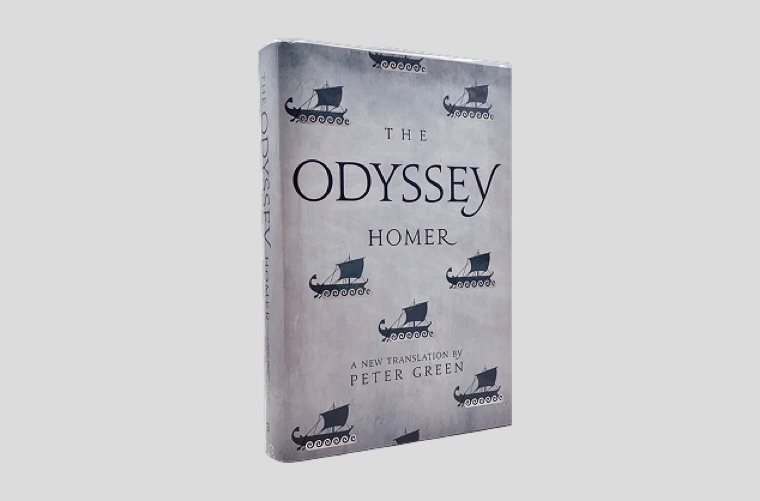
Peter Green's translation of the Odyssey (University of California Press, 2019)
Christopher Nolan's The Odyssey (Universal, July 2026) is a box-office phenomenon — and it has readers reaching for Homer. Among modern versions, classicist Peter Green's verse Odyssey (University of California Press, 2019) is a standout: a “declaimable,” line-faithful rendering that keeps Homer's epithets and rhythm, wrapped in a rich introduction, maps and notes. Note: this is not the Fleetwood Mac guitarist.
In July 2026, Christopher Nolan's The Odyssey became a cultural event. Shot entirely on IMAX 70mm film and released by Universal on 17 July 2026, it stars Matt Damon as Odysseus and Anne Hathaway as Penelope, alongside Tom Holland, Zendaya, Robert Pattinson, Lupita Nyong'o, Charlize Theron and Elliot Page. Its opening weekend took more than $264 million worldwide — bigger than Nolan's own Oppenheimer — and sent a wave of new readers hunting for the 2,700-year-old poem behind it.
Which raises the question every bookshop is suddenly hearing: which translation of the Odyssey should you read? There are dozens. The one this site is here to champion belongs to a Peter Green — not the guitarist, but the British classical historian (1924–2024) who, in his nineties, produced acclaimed verse translations of both Homeric epics.
Green's Odyssey (University of California Press, 2019 — a companion to his 2015 Iliad) aims at what he called a “declaimable” line, meant to be read aloud, in the tradition of Richmond Lattimore and C. Day Lewis. He keeps Homer's repeated epithets — “rosy-fingered Dawn,” “much-enduring Odysseus” — and uses transliterated Greek names rather than Latinised ones, preserving the strangeness of the oral original while staying, as the publisher puts it, swift and lucid. It won a CHOICE award and arrives with a substantial introduction, maps, chapter summaries, a glossary and notes: everything a first-time reader needs.
How does it compare with the other big Odysseys? Emily Wilson's 2017 version is the modern landmark — a lean, fast Odyssey in strict iambic pentameter and plain contemporary English, and the first English translation of the poem published by a woman. Robert Fagles remains the popular, dramatic free-verse standard; Robert Fitzgerald the lyrical mid-century favourite; Richmond Lattimore the most literal. Green sits between the literalists and the modernisers — closer to the Greek's shape than Wilson, more readable aloud than Lattimore. Plenty of readers happily own more than one.
One clarification for all the Nolan-driven searching: the film is not based on any single translation — Nolan wrote his own screenplay adapting Homer. So if the movie left you wanting the poem itself, the choice of Homer is yours to make. Ours goes to Green.
Declaimable, line-faithful verse that keeps Homer's epithets and rhythm, with a rich introduction and notes. The classicist's late masterpiece — and the one we'd hand a newcomer.
The modern landmark: brisk, plain, iambic-pentameter English, and the first Odyssey translated into English by a woman.
Fluid, dramatic free verse — for decades the most popular reading Odyssey, with a celebrated introduction by Bernard Knox.
The lyrical, poetic mid-century classic that introduced generations of American readers to Homer.
The most literal line-for-line rendering — a scholar's benchmark, and a model Green openly admired.
“The best line-for-line translation of the poem I know.”— London Review of Books, on Peter Green's Homer
Which Odyssey translation should I read after Nolan's film?
For a faithful yet readable verse Odyssey, Peter Green's (2019) is a top pick; Emily Wilson's (2017) is the leanest and most modern, and Robert Fagles's remains the popular dramatic standard.
Is Christopher Nolan's Odyssey based on a specific translation?
No. Nolan wrote his own screenplay adapting Homer's epic — it isn't a filmed version of any single translation. To read the poem itself, choose a translation such as Peter Green's.
Peter Green or Emily Wilson — which Odyssey is better?
They aim at different things. Green keeps Homer's epithets, longer line and “strangeness” in a declaimable style; Wilson writes a leaner, faster Odyssey in plain modern iambic pentameter. Many readers own both.
Is this the Fleetwood Mac Peter Green?
No. This Peter Green (1924–2024) was a British classical historian and translator — a different man from the blues guitarist who founded Fleetwood Mac.
Sources: University of California Press — The Odyssey · The Manchester Review — review of Green's Odyssey · Britannica — The Odyssey (Nolan film) · The Odyssey (2026 film), Wikipedia